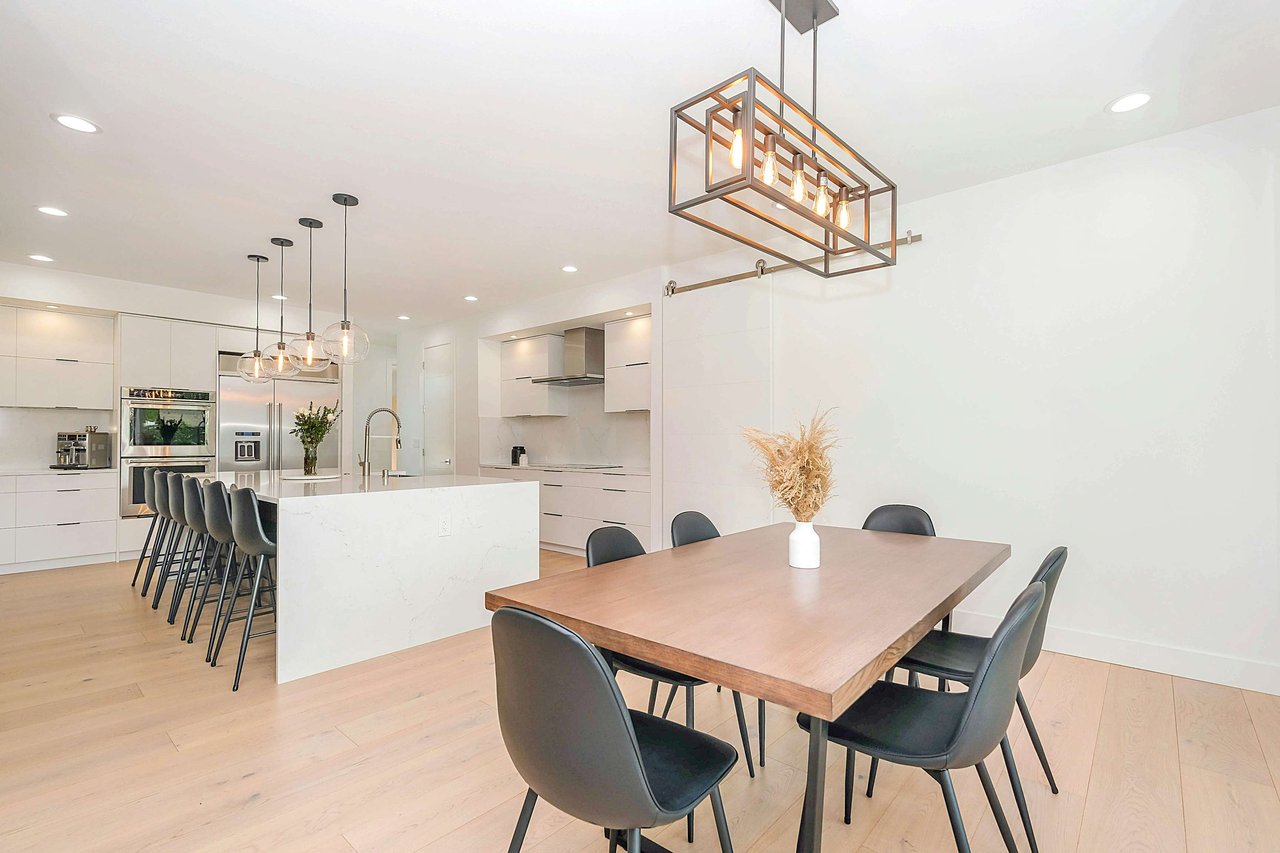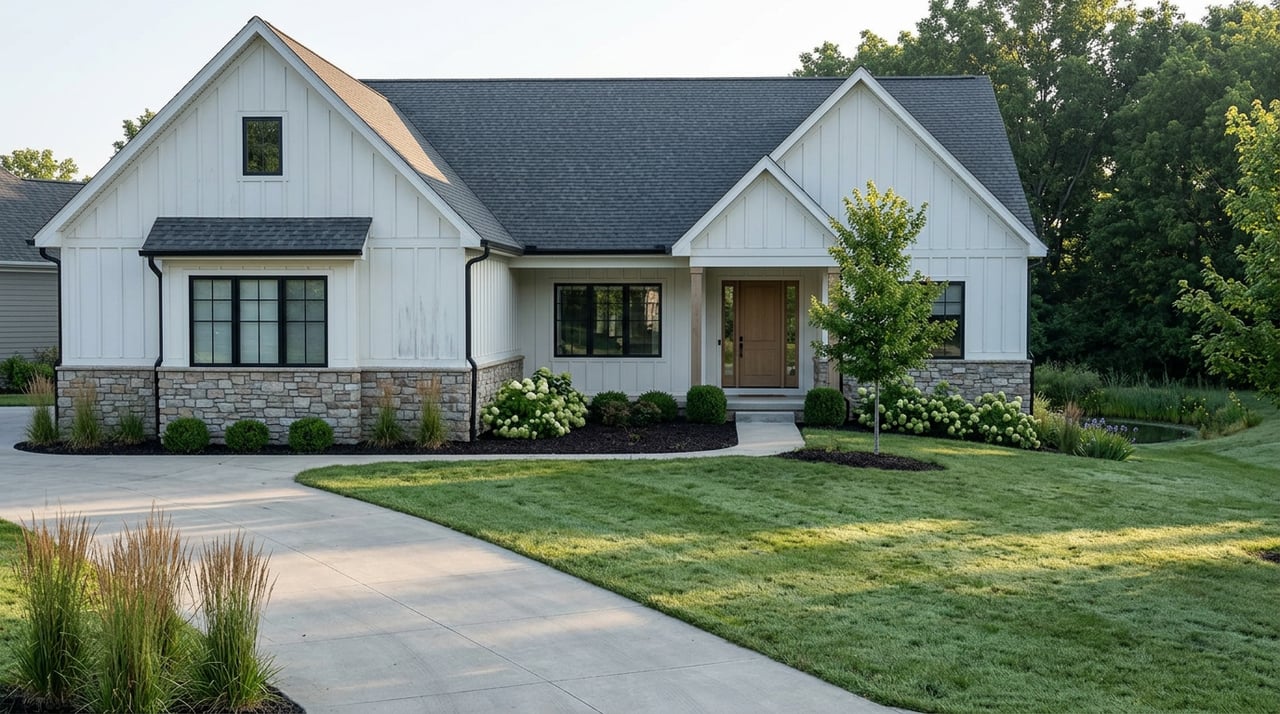
Three homes in Fort Wayne's Bentley Estates community are listed at exactly $379,900. One measures 1,451 square feet. Another measures 1,612. The third measures 1,776. Buy the smallest one and you're paying close to $262 a square foot. Buy the largest and that number drops to roughly $214. Same builder, same subdivision, same price tag on the sign, and a $48-per-square-foot gap between them depending on which lot you pick.
That gap is the whole story of new construction pricing in Fort Wayne right now, and it's the part most price ranges don't explain. When a community's marketing page says "priced from the $280s to the $330s," it reads like a single product with a sliding scale. It isn't. It's usually two or three different floor plans stacked into one range, and the square footage attached to each price is doing more work than the price itself.
What a Community's Price Range Is Actually Telling You
Take Thunderhawk, a D.R. Horton community in Northwest Fort Wayne with 32 planned homes across eight floor plans. The community-wide range runs from $280,000 to $335,000, with homes spanning 1,498 to 2,600 square feet. Run the math on the extremes and the per-square-foot cost swings from about $108 on the largest plan at the lower price point to roughly $224 on the smallest plan at the upper price point. That's not a rounding difference. It's the difference between a home that's a genuine value on a square-footage basis and one that's priced like a much smaller custom build.
Compare that to what Fort Wayne's resale market has been doing. As of mid-2026, the median resale price per square foot across the city sat at $144, up 6.7% year over year, with the median sale price over the trailing three months at $230,000, according to Redfin's tracking of MLS and public record data. Fort Wayne's broader August 2026 listing figures put the citywide median at $299,000, or $156 per square foot, per Movoto's MLS-sourced numbers. So depending on which specific floor plan in which specific new-construction community a buyer is looking at, new construction in Fort Wayne right now can land meaningfully below the resale per-square-foot benchmark, right around it, or nearly double it. The community's advertised range doesn't tell you which one you're getting. The floor plan does.
Here's how that plays out across a handful of actively marketed communities:
| Community | Builder | Location | Example Price | Square Footage | Effective $/sq ft |
|---|---|---|---|---|---|
| Thunderhawk | D.R. Horton | Northwest Fort Wayne | $280K–$335K | 1,498–2,600 | ~$108–$224 |
| Bentley Estates | Granite Ridge Builders | Fort Wayne | $369,900–$379,900 | 1,451–1,776 | ~$214–$262 |
| Oaklynn Reserve | Granite Ridge Builders | Fort Wayne | $534,900 | 1,923 | ~$278 |
| Greyson Heights | Granite Ridge Builders | Auburn, IN | $591,900 | 2,056 | ~$288 |
| Citywide resale (3-mo. avg. through June 2026) | — | Fort Wayne | $230K median | — | $144 |
The pattern holds across both builders represented here. Inside a production community like Thunderhawk, the biggest spread in value sits between floor plans. Inside a custom builder's portfolio like Granite Ridge's, the spread sits between communities and lot types, and it climbs steadily as square footage and finish level increase. Neither number is wrong. They're just answering different questions, and a buyer comparing "new construction in Fort Wayne" as if it were one market is comparing apples that happen to share a zip code.
Custom Building Spreads the Range Across Geography, Not Just Floor Plans
Granite Ridge Builders operates from a 15,000-square-foot showroom on Woodland Plaza Run and offers more than 180 floor plans across a scattered set of communities: Bentley Estates and Oaklynn Reserve inside Fort Wayne, Carroll Creek off Carroll Road with views of a 12-acre pond, Cedar Grove in Roanoke near Interstate 469, Forest Cove south of town in Markle, Orchard Valley and Orchard Valley Reserve up near Avilla and Kendallville, Greyson Heights out in Auburn, and Park Meadow, a 24-acre, 60-lot community down the street from Martin Kenney Memorial Park.
That geographic spread means the custom-builder comparison isn't just about price per square foot. It's about which school district and which drive time comes attached to which price point. A buyer weighing Bentley Estates against Oaklynn Reserve isn't just choosing a floor plan and a $155,000 price difference. They're choosing between two different sides of Fort Wayne with different commute profiles, and the per-square-foot number only tells part of that story.
Financing adds another layer specific to certain lots. Magnolia Meadows, a Granite Ridge community in southwest Fort Wayne off West Hamilton Road, is marketed with a 0% down 502 Direct Loan and special financing program alongside its standard pricing. That's not available community-wide. It's tied to that specific location, which means the "effective cost" of building there can look different from the sale price alone before a single upgrade gets chosen.
The Sale Price Isn't the Payment. The Payment Has More Line Items Than the Sign Suggests.
D.R. Horton's own financing examples make this explicit. A Thunderhawk example built around a $342,550 sales price and a $325,422 loan amount produces a total estimated monthly payment of $2,336, a figure the builder states includes principal, interest, estimated taxes, mortgage insurance, and HOA. A comparable Belmont Woods example in Northeast Fort Wayne, built around a $347,846 sales price, produces a monthly estimate of $2,379.
That HOA line matters more than it looks. Across the handful of homeowners associations tracked by CommunityPay in Allen County, the median monthly HOA fee runs $203. That's a real, recurring cost that doesn't show up when a buyer is comparing sale prices side by side, but it does show up every month for as long as they own the home. Two communities priced identically on paper can carry very different total monthly costs once that fee is added, and a buyer who's only comparing the number on the yard sign won't see it until closing disclosure.
The Advertised Rate Comes With an Expiration Date
The other detail buried in these builder financing examples is timing. D.R. Horton's Belmont Woods incentive, tied to that $2,379 monthly example, applies only to contracts signed on or after August 1, 2026 and closed by October 30, 2026, a roughly two-month window that's running now but has a hard end date. The rate also applies specifically to financing through DHI Mortgage Company, the builder's in-house lender. A buyer isn't required to use that lender, but they're required to use it to get the advertised number.
That's worth sitting with before comparing two communities' payment examples as if they were apples to apples. One builder's advertised monthly figure might assume a lender-subsidized rate available only through a captive mortgage arm and only within a specific contract-to-close window. A custom build through Granite Ridge, running on a longer timeline with no single publicized rate promotion, isn't automatically the more expensive path once that context is factored in. It's a different financing structure entirely, and the comparison only makes sense once both numbers are stripped down to what they actually assume.
What This Means Measured Against the Rest of the Market
Zoom back out to the city level and the picture gets one more layer of context. Fort Wayne's average home value stood at $249,481 as of the end of July 2026, up 2.7% over the past year. A recent mid-year review of the local housing market noted that supply is loosening after several tight, price-driven years, giving buyers more homes to choose from even as affordability keeps a lid on overall activity. Locally, appreciation has been running around 3% with new listings up roughly 9% and days on market up around 21% compared to a year earlier, according to a recent review of Fort Wayne market conditions.
Set against that backdrop, the real question for a new-construction buyer in Fort Wayne isn't "is new construction more expensive than resale." It's "which specific floor plan, in which specific community, financed through which specific lender, on which specific timeline" is actually being compared to that resale benchmark. The community brochure won't answer that. The floor plan sheet, the HOA disclosure, and the lender's rate sheet will.
A Few Questions Worth Asking Before You Compare Two Communities
Does the advertised price include the HOA, or is that a separate monthly line? Ask for the total estimated payment, not just the sale price, and confirm whether that estimate already includes an association fee.
Is the advertised rate tied to the builder's in-house lender? If so, ask what the payment looks like using an independent lender's rate, since the two numbers can diverge once the promotional window closes.
What's the actual square footage behind the price you're quoted? A single community can span an $80,000 spread in price and an equally wide spread in square footage. The number that matters for value is the ratio between them, not either figure alone.
If you're weighing a production community against a custom lot somewhere in Northeast Indiana and want the real numbers side by side, including current builder incentives and what a specific floor plan actually runs per square foot, Michael Lee works directly with Granite Ridge Builders on lot selection and contract terms and can walk through the comparison with you. Let's Connect.